Monday, April 18, 2011

the stylist


Can you help me identify these two vintage caffeine-fed babies I found at a thrift shop? They seem to be jack and jill, mascot for a particular brand, or hansel and gretel.


An illustrator can be a stylist. I realized that for children's books, style doesn't need to be consistent for the illustrator's entire body of work. I think that each story has its own unique ambience or mood that the illustrator should create. Every illustrator can have their own take on a story. But I don't think an illustrator should render the same style to another story. Unless it is a part of a series, it will create confusion whether it is a continuation of another story rendered in the same style or a totally different story. Style should rather be progressive or "translatable" to succeeding works. Or, if style persists, then it should match the spirit of the story. What should be consistent is quality.

Maurice Sendak perfectly sums up my view on style, quoted from Humorous Illustration by Nick Meglin:

"Style to me is purely a means to an end and the more styles you have, the better. One should be able to junk a style very quickly. I think one of the worst things that can happen in some of the training schools for illustrators is the tremendous focus on 'style' as preparation for coming out into the world and meeting the great horned monsters—book editors—and how to take them on. Style seems to be one of the things you learn as a defense. It's a great mistake. To get trapped in a style is to lose all flexibility. I've worked very hard not to get trapped in that way. ...

Each book obviously demands an individual stylistic approach. If you have one style, then you're going to do the same book over and over. That, of course, is pretty dull. Lots of styles permit you to walk in and out of all kinds of books. It's a great bore worrying about style. My point is to have a fine style, a rough style, a fairly slim style, and an extremely fat style."

Now here comes a personal dilemma: I did some illustrations using a different style that wasn't originally my intention nor enjoy rendering, the style was suggested by the client for me to pursue. I know I can render anything from realistic to whimsy, and the illustration profession is not for ego's sake, but my confidence level went down because I felt my vision for the story was extremely compromised. I felt I was merely an "illustrator" and not co-creator. I was thinking perhaps if I sticked to one style that I really love doing and be proud of, I would have been much happier working on it. Were my friends correct all along when they said staying to a specific style is better in the long run?

The eternal question is, should I persist or digress?

Art vs. Craft


a preview of my diorama illustrations for an upcoming book.

In recent years, the easy access of information through the web revived different forms of craft. Creators all over the world influence each other through their work. More artists are gathering much interest on handmade objects created through sewing, knitting, crocheting, pottery, jewelry, paper architecture, and manual printing methods. How I wish we can also revive the indigenous crafts of our ethnic tribes, where most of them are actually dying! One of the finest weaving techniques of the Bagobo is gone.

A discourse on craft vs. art is endless and craft objects still elicit a silent rejection in the art world, despite the ideas of postmodernism defied the hesitation of elevating craft as fine art. Craft objects, which include illustration and comics, are  considered "lowbrow art," or art that is not seriously recognized as fine art in the high or elitist art world, where art are revered only those found in museums and galleries by the rich and the intellectual.

I have heard of an accomplished children's book illustrator's story where a gallery rejected his works for exhibit only because they are children's book illustrations. If they are just children's book illustrations, why is it then that the world has to bestow an award to recognize excellence in this field?

But how can then craft be called art, when these objects were made for a specific purpose? But isn't art were also made with a specific purpose in mind?("to visibly express the abstract nature of idea" by painting that idea on a canvas). I think, artists today only use the techniques of craft to achieve a profound effect other than it's utilitarian purpose. That's what makes craft more than just a craft.


works in progress


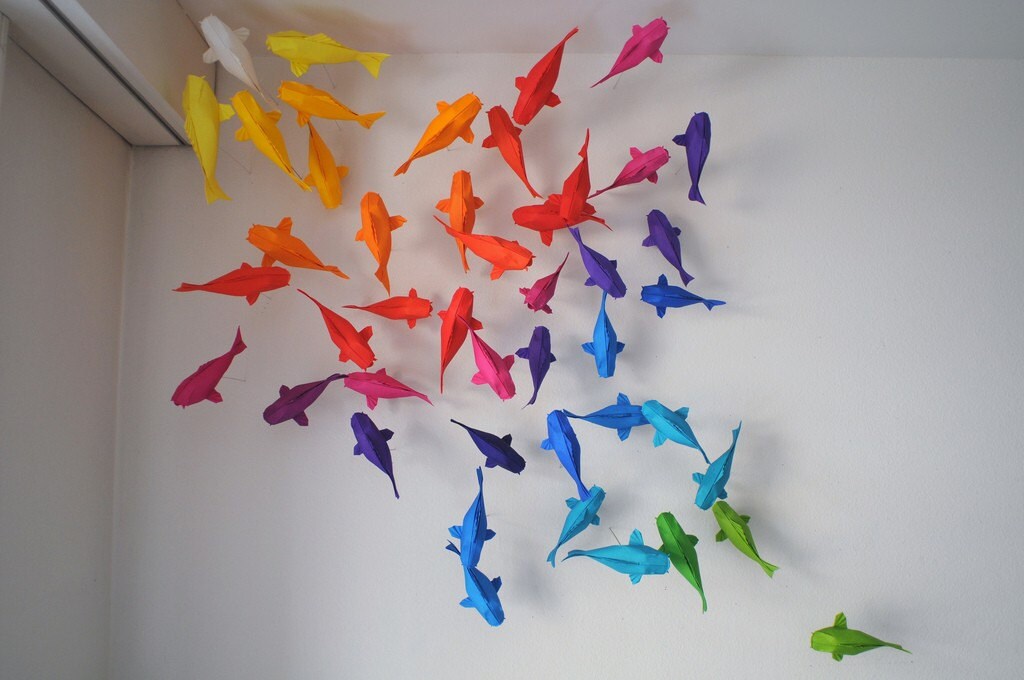
I was struck by this photo of colored kois, so I searched how to fold this wonderful origami. This particular koi origami was designed by Sipho Mabona. You can also make your own koi in a video here.


Laying out the pieces before painting them and compose them inside the index card boxes. I so love dioramas, they just create so much drama! It looks fun to do, but actually, it's more than just fun.


I had to draw each element and cut every piece.


The face is made of air-drying clay, then painted with acrylics. This style is very tedious but in the end, I know it's all worth it.


The faces are ready while I took a shot to know which angle will make their shadows look their best.


This is another origami I learned on the web, unfortunately, I can't find the original source. You can make this origami as a paper lantern when you put several pieces together. I will be posting a tutorial on how to create and fold them from a whole cartolina.


The past months I've been very busy finishing these illustrations and the work took awhile because I had to document every process in between. An artist used to just paint and make beautiful things then show it after. Today, you have to document the work not only to secure its intellectual property rights but also as a contribution to knowledge.

birds, lovely creatures


birds outside my window

Wish I could fly like a bird. I think it's the loveliest creature on earth, aside from fish, horse, puppy, kitten, and baby.


Sunday, March 6, 2011

Noah's Pup


This is my favorite scene from the book, Ang Tuta ni Noe.

I am very honored to illustrate and now pleased to introduce my recent children's book, Ang Tuta ni Noe (Noah's Puppy) written by the National Artist for Literature himself, Virgilio Almario. For me, he is the Philippine's father of modern children's books because he is one of the pioneering promoters of children's literature in the country. It was one of the toughest book project I have ever illustrated because not only of its very high expectations (Sir Rio is also a critic) but also I had to research and fill the pages with so many animal characters at the least possible time.

The project's story is very memorable to me because it was given to me at the time when Metro Manila was rampaged by the mega typhoon Ondoy. It was also the screening of the film 2012, so imagine the feeling I had as if I was on a great deluge myself...I thought how coincidental this project must have been when all the signs are coming up. It was a challenge, but I was ready.

When I reviewed the story, at first I haven't foreseen the tremendous work of creating many characters the book project entails. But the daunting task mellowed out for the excitement in me because I so love dogs and the plot was not an ordinary retelling of the story of Noah's ark, and Noah wasn't even the star!


If you'd like to know what happened to Noah's puppy, you can get the awesome book here.

And if you also like birds, as much as I do, inspired from this spread from Ang Tuta ni Noe, I made several new imaginary bird species:


Soar


Smile


Hope


Yes, after watching The Black Swan starring Natalie Portman, then reading the story Ang Tuta ni Noe, why not get some bird prints on various applications at Red Bubble. I know you love Angry Birds, but cutie birds are lovely too!


Friday, February 25, 2011

foto me


elegy for a friend

golden paper

japanese armada

beautiful toxic maker

skinny dipping

heroes where are thou?

All postcards and prints available here.